As you look for lift kits and truck accessories in Reading, first decide whether a leveling kit or full suspension lift is right for you. A leveling kit corrects factory rake and maintains daily manners, while a suspension lift provides clearance, wheel travel, and larger tire fitment. Make sure you have precise year, trim, drivetrain, and suspension details to verify Rough Country fitment. Plan your budget for tires, alignment, and accessories including steps, lights, or liners—you'll see how the right setup takes shape.
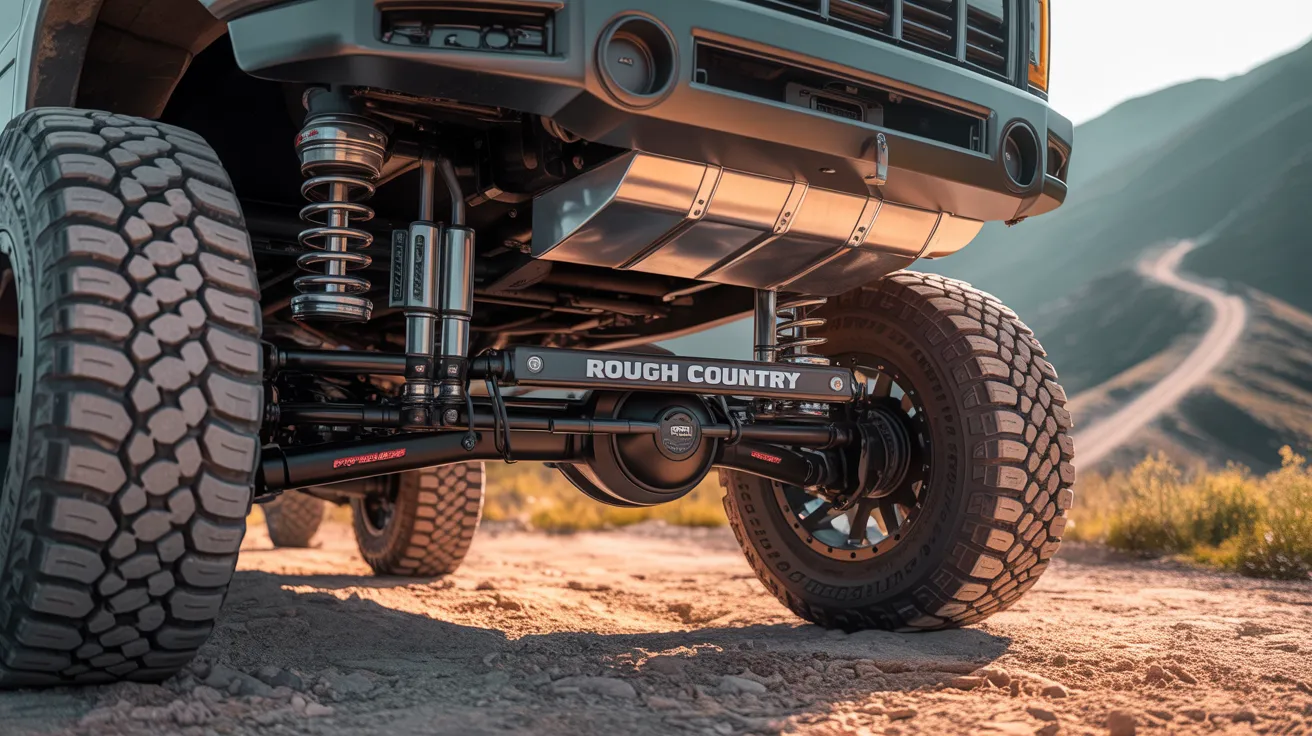
Important Highlights
- Opt for a leveling kit to eliminate factory rake while maintaining near-stock performance and fitting bigger tires for daily driving.
- Go with a suspension lift for enhanced clearance, suspension travel, and off-road performance, understanding handling and steering may shift.
- Validate proper fitment using your truck's year, make, model, drivetrain, trim, cab, bed, and suspension package prior to ordering your Rough Country parts.
- Match lift height and shock absorbers to your use, whether commuting, mixed trail driving, towing, or heavier off-road travel.
- Reserve budget for beyond the kit cost alone, including alignment, labor, wheels, tires, shocks, and supporting accessories like steps, lights, and liners.
Suspension Lift Kits Against Leveling Kits
Even though both upgrades change your truck's stance, suspension lift kits and leveling kits solve different problems and give unique results. A leveling system tends to raise the front to meet the rear, correcting factory rake with minimal change to geometry, ride height, and daily drivability. You select one when you seek a cleaner profile and room for slightly larger tires.
A suspension lift raises the entire truck and changes key components to create greater clearance and wheel travel. You'll experience larger improvements in ride height, off-road capability, and tire fitment, however you must prepare for handling tradeoffs, steering shifts, and an elevated center of gravity. If you prefer subtle visual improvement, level it. When you need real clearance and articulation, go with a suspension lift and structure the supporting mods according to your driving needs.
What Rough Country lift kit works best for your truck?
To identify the right kit, start with your truck's year, brand, and model, drive configuration, and expected usage, because Rough Country builds lift kits around exact platform geometry and performance targets. That baseline tells you which brackets, struts, spacers, crossmembers, and hardware will actually install properly without clearance or alignment problems.
Next, examine factory ride height, cab and bed configuration, axle type, and whether your truck features 2WD, 4WD, or adaptive suspension. Rough Country fitment documentation make this easy, but you still need to verify fitment accuracy against trim-specific hardware and OEM package differences. A kit that fits a Silverado 1500 may not fit a Trail Boss, and a Ram helpful information with air-spring suspension necessitates different modifications than a vehicle with coil springs. By confirming fitment upfront, you prevent install surprises, compatibility issues, and return hassles.
Determine which Rough Country lift kit suits your driving preferences.
Select the kit to your driving patterns, and you'll receive better ride quality, lasting performance, and additional tire clearance without spending on unused features. If your truck spends most days commuting, pick a light leveling kit from Rough Country or a 2- to 3.5-inch suspension setup designed for commuting comfort and predictable steering behavior.
If you divide time between road and off-road use, go with a suspension lift equipped with upgraded shocks and corrected control arm angles. You'll experience stronger off road handling, superior articulation, and room for larger tires without straining OEM components. For serious trail work, prioritize lifted shock struts, N3 or Vertex shock dampers, and suspension systems that preserve driveline geometry under load. The correct Rough Country kit needs to match load capacity, speed, and terrain, and how much ride firmness you'll actually tolerate.
Premium Rough Country Truck Accessories
Complete your new lift system including Rough Country add-ons that tackle the real problem areas you'll see once you lift it and add bigger tires. Go with upgraded steps or side sliders, which recover ease of cabin entry and provide side protection when your truck sits higher and wider.
Next, emphasize view and handling. Rough Country LED light bars extend usable vision on dim trails, jobsites, and remote roads without complicated integration. Interior covers and floor mats protect cabin components from mud, stones, and water you'll bring in from trails. Wheel flares reduce mud spray and complement the wider look created by larger tires. For towing or recovery, robust hitches, pulling hooks, and winch-capable bumpers provide capability without sacrificing compatibility. Go with products that align with your truck's new geometry and usage demands.
How Much Should You Budget for Your Build?
Once you've picked the suspension kit and supporting accessories, set a budget that covers more than the base kit cost. You'll need room for shocks, wheels, rubber, alignment, installation labor, and any suspension or steering modifications your platform requires. Brand reputation matters here; high-end kits usually deliver more precise specifications, better ride quality, and smoother installation. tighter tolerances, better ride quality, and fewer install headaches.
Regarding realistic budget ranges, expect entry-level spacer or leveling setups to start at lower prices, while comprehensive suspension packages with control arms, tuned dampers, and bigger tires rise quickly. Install complexity, shop rates, and calibration work may contribute significantly. You ought to budget supporting upgrades like gear changes, brake components, and recovery gear if you intend for off-road use. When budget is tight, assess payment alternatives meticulously and emphasize consistency rather than fancy extras.
Common Questions Answered
How Do Lift Kits Influence Warranty Coverage?
Yes, lift kits can impact your factory warranty coverage, but they won't automatically nullify it. You experience warranty implications if a dealer shows the lift modification caused or contributed to a defect. Powertrain, steering, suspension, and drivetrain claims frequently spark dealer disputes. You must maintain documentation of installation, purchase quality parts, and follow service intervals. That helps you dispute rejected claims and maintain coverage in situations where the modification didn't contribute.
Do Bigger Tires Mean Re-Gearing?
Yes—if you move up multiple tire sizes, you'll often require re-gearing. As an example, if you switch from 31-inch to 35-inch tires, your vehicle can feel slow, shift erratically, and create drivetrain strain when loaded. Re-gearing restores proper gear ratios, allowing you to recover acceleration, towing performance, and transmission behavior. You might not need it for a minor upsizing, but if power, fuel economy, or shift quality drop, it's usually the right call.
When Should You Check Your Lift Kit?
You should inspect lift kit components after the first 500 miles, then during each oil change or every 3,000 to 5,000 miles, based on use. Periodic inspections allow you to identify bushing degradation, shock leakage, bracket damage, and alignment problems early. Verify bolt tightness after hard off-road runs, towing, or impacts. If you drive in mud, salt, or rough terrain often, shorten intervals and check steering parts and suspension components at shorter intervals.
Will a lift kit affect towing or payload capacity?
Yes, a lift kit can alter your towing and payload capacity. When you elevate ground clearance for more ground clearance, you change suspension angles, gravitational center, and leverage on components. That can decrease stability under load and amplify drivetrain stress, especially with larger tires. You should obey your OEM ratings unless an certified engineered kit clearly details upgraded ratings. Proper alignment, gearing, and brake effectiveness are also critical.
Are wheel alignment Required Once You Install vehicle modifications?
Yes—if accessories alter ride height, suspension configuration, steering angles, or tire size, you need an alignment service. You'll feel the theory fast: slight changes can make your truck drift off-center, scrub tread, and worsen handling characteristics. A full alignment restores camber, caster setting, and toe setting to spec. After certain installs, you may also need brake calibration for driver-assist accuracy. You safeguard tire life, steering sharpness, and real-world safety by checking alignment immediately.
Wrap-Up
Picking the right lift package and components comes down to your truck usage, your desired look, and what your budget can handle. When you match a Rough Country kit to your driving style, you'll get power, ground room, and style which coordinate like a well-tuned drivetrain. Add intelligent upgrades, organize your budget responsibly, and you'll assemble a pickup which becomes practical on the road, capable off it, and set for any future work.
Comments on “Reading Truck Wheels & Tires”